The Oculus Rift virtual reality headset
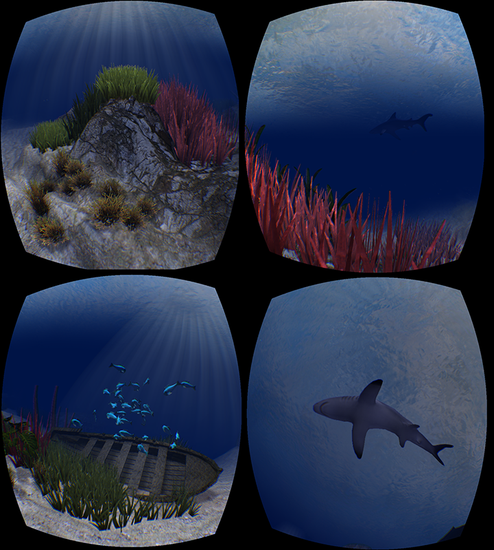
The Oculus Rift virtual reality headset is one of the most talked about technologies of 2013, with many proclaiming it and similar devices could revolutionise the way people experience interactive content in the coming years.
Dr. Llyr ap Cenydd from the School of Computer Science at Bangor University has sought to explore what could be possible with this new immersive technology by developing prototype experiences in his spare time over the Summer, using an Oculus Rift development kit he funded through Kickstarter.
YouTube video : http://www.youtube.com/watch?v=tUEXgpOQYe0
Ocean Rift is a virtual deep sea diving experience specifically designed for the Oculus Rift. In the tech demo users can explore the sea bed and meet a number of different shark species, schooling fish and humpback whales.
The idea behind Ocean Rift was to explore different techniques for immersing someone in an underwater environment. This included experimenting with how to simulate player movement, the use of sound, animals, plants, special effects and particle systems (e.g. detritus, dust and air bubbles).
The most infamous inhabitant of Ocean Rift is the hungry prehistoric Megalodon shark that lives in the deeper parts of the simulation. While Ocean Rift is mostly a benign experience, players are warned not to venture too far into the deep, and numerous anecdotal blog posts and YouTube reaction videos are testament to how realistic virtual reality can be when this advice is ignored!
Ocean Rift v1.01 can be downloaded here.
YouTube video : http://www.youtube.com/watch?v=H2euG3HrU1c
Crashland is a first person shooter (FPS) prototype for the Oculus Rift. The player is stranded on a hostile alien planet with only a gun and motion scanner to defend themselves. Crashland aims to show what games of the future could look like when combined with immersive virtual reality and motion control. There are two novel technologies driving the game's mechanics.
Firstly Crashland aims to provide full body awareness. While wearing an Oculus Rift, the player also holds a Razer Hydra motion controller in each hand. In the game, as the player looks down at their arms and virtual body their avatar will copy their movements 1:1. This enables a much more natural and immersive way of playing an FPS as the player is able to move their hands and aim weapons independently of head movement, freeing them to develop their own unique style of movement and combat. Even simple things like the player's shadow can be very evocative, as it duplicates what the person is doing in the real world.
The second novel aspect of Crashland is the animation system. Based on previous research by Llyr, the alien creatures of the game are driven by a dynamic animation system that physically simulates their virtual muscles, producing unique and contextual motion for every situation and interaction.
An early version of Crashland was released in August 2013 and community feedback has been overwhelmingly positive.
Crashland v0.3 can be downloaded here.
